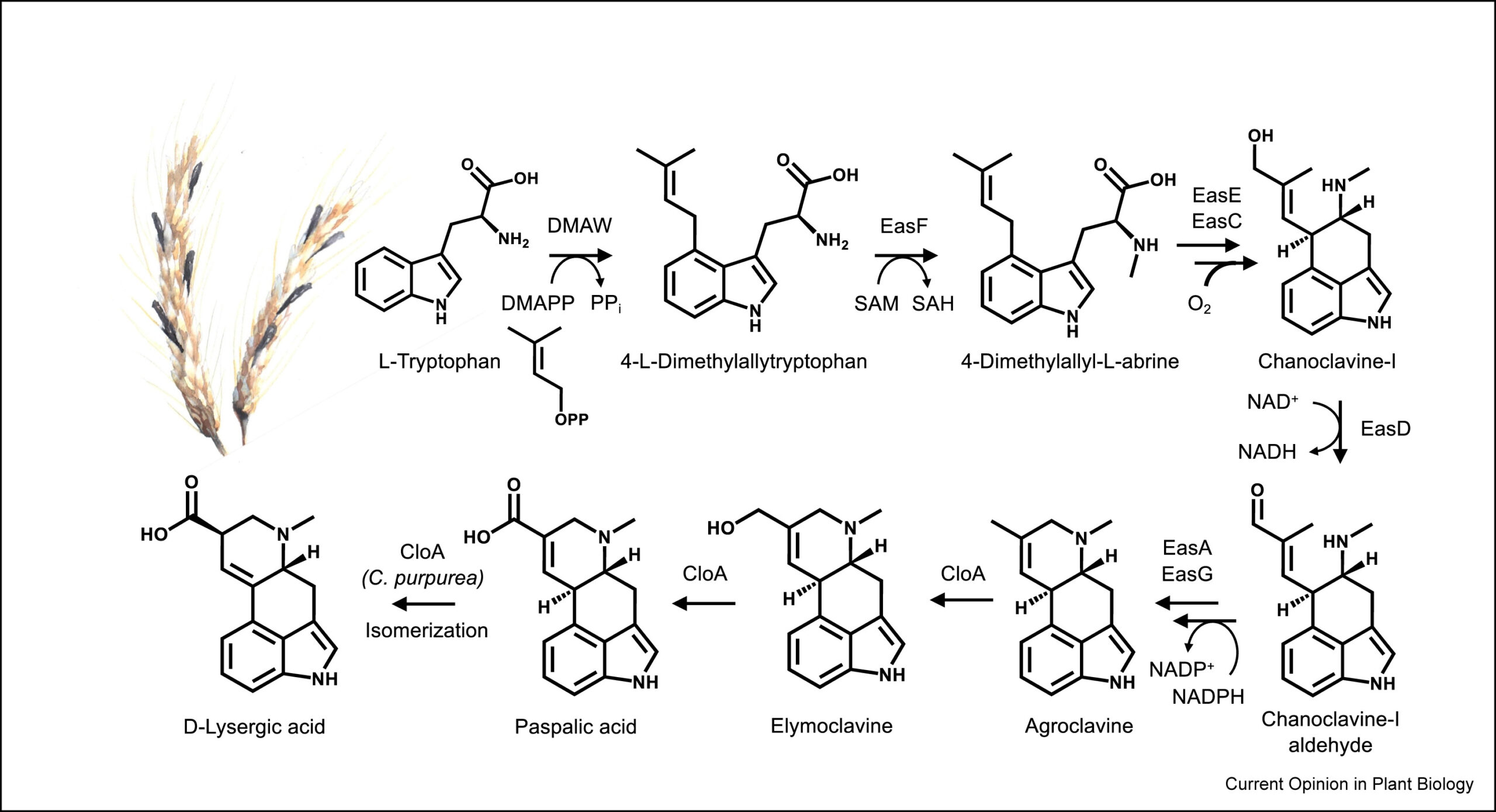
Rendering of rye (Secale cereale) infected with ergot fungus (Claviceps purpurea) to illustrate ergot’s biosynthesis of lysergic acid, the precursor to LSD. Published in Current Opinion in Plant Biology Vol. 82: 102626 (2024) https://doi.org/10.1016/j.pbi.2024.102626. Open access, used with permission.
Ergot is a fungal disease particularly damaging to rye, emerging as characteristic black spurs in the grain head called “Mother-of-Rye.” Throughout history, ingestion of infected bread has caused severe outbreaks of ergotism (St. Anthony’s Fire), leading to gangrene of the limbs (“burning” pain), convulsions, and hallucinations. A major phytochemical component of ergot is lysergic acid, which is readily converted to lysergic acid diethylamide (LSD). Beyond recreational use, scientific research has revealed promise for LSD and other psychedelics in the treatment of Major Depressive Disorder (MDD) and other psychiatric conditions.