Peyote (Lophophora williamsii) is native to the Chihuahuan desert in North America. Archeological evidence supports its use by indigenous peoples for at least 5,500 years. Traditionally deployed in rituals and ceremonies, its principle phytochemical mescaline – a potent hallucinogen – is under scientific study for use in the treatment of Major Depressive Disorder (MDD) and other psychiatric diseases.
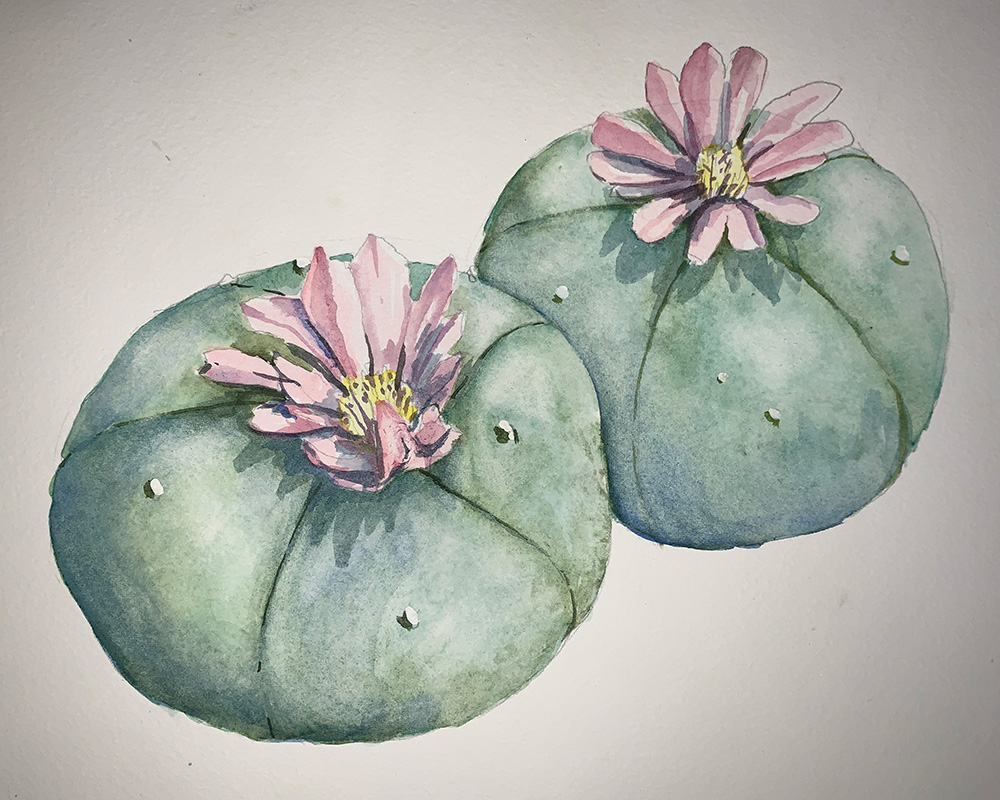
I was commissioned in 2025 to paint peyote buttons to illustrate a scientific article on psychedelics, now available here https://doi.org/10.1016/j.pbi.2024.102626.
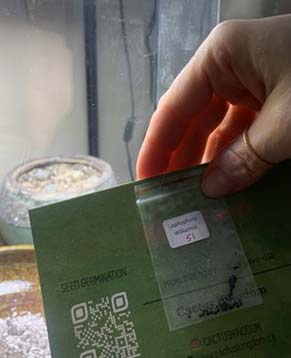
I try to start plants from seed, which can be challenging for species like peyote which are obscenely slow growing. Luckily, you can purchase the plant in Canada (but it can’t be shipped across borders). A point of interest for the scientific community is how/why peyote is hallucinogenic, but close relatives are not. To help answer this question, scientists at the University of Calgary (Prof. Peter Facchini, Prof. Samuel Yeaman, graduate students and post-docs, including Dr. Jacinta Watkins and Ginny Li) have elucidated how peyote uniquely biosynthesizes mescaline and will soon publish on its genome.