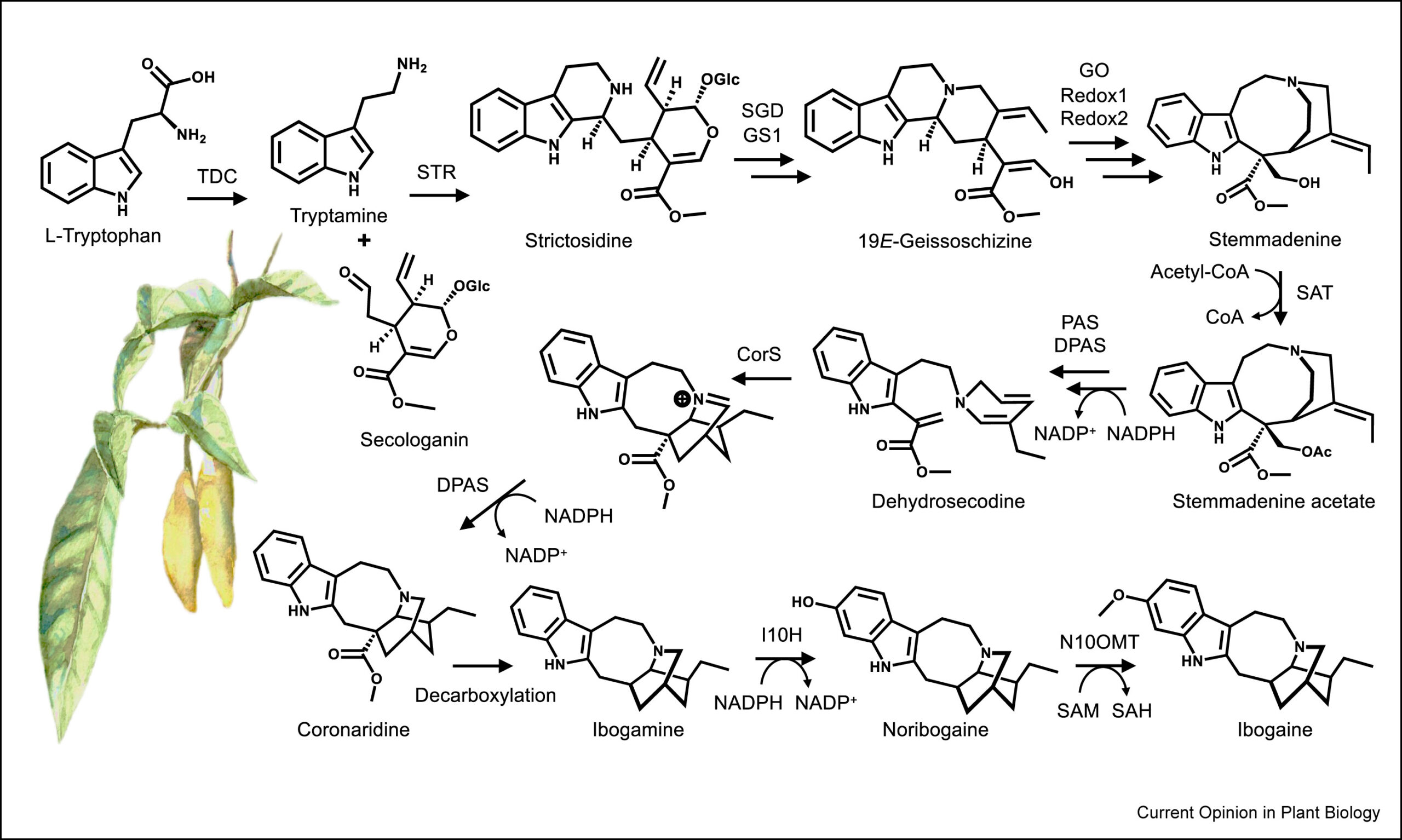
Botanical rendering of an iboga branch (Watercolour on paper) to illustrate the plant’s biosynthesis of ibogaine. Published in Current Opinion in Plant Biology Vol. 82: 102626 (2024) https://doi.org/10.1016/j.pbi.2024.102626. Open access, re-used with permission.
Iboga (Tabernanthe iboga) is an evergreen shrub native to western equatorial Africa. The bark and root of iboga have been used for centuries in traditional medicine and ritual practices. Higher doses of iboga induce hallucination, dream-like states, and near-death outcomes. Howard Lotsof is credited with bringing iboga to the attention of Western medicine with his serendipitous discovery that iboga – despite its side effects – can alleviate opioid withdrawal symptoms. An important phytochemical made by iboga underpinning this prospective medical application is ibogaine, a complex molecule that is difficult to synthesize commercially. Owing to the perceived cardiac risks of ibogaine, analogues are being explored.